
How to Run a Mobile Pet Grooming Business From a Van in 2026
Roali (Roy) Biten
Founder, ROXO Hub · April 2, 2026
Streamline Your Mobile Grooming Business
Stop managing bookings from your phone while driving. ROXO Hub gives mobile groomers 24/7 online booking, auto reminders, digital waivers, and tap-to-pay — all for $39.99/month.
Start Your TrialIn this article
- 1.1. Set Up Your Van for Efficiency and Safety
- 2.2. Plan Your Route to Minimize Dead Miles
- 3.3. Run a Pre-Shift Equipment Check Every Morning
- 4.4. Follow a Pet Safety Protocol on Every Visit
- 5.5. Build a Scheduling System That Eliminates No-Shows
- 6.6. Track Your Revenue and Fuel Costs Weekly
- 7.The right tool makes this easier
- 8.Frequently Asked Questions
How to Run a Mobile Pet Grooming Business From a Van in 2026
Mobile pet groomers operating from a van average $65,000–$90,000 per year — but nearly one in three burns out within 18 months from route chaos, no-shows, and equipment failures they never planned for. A disorganized schedule doesn't just waste fuel; it costs you 3–5 appointments per week in dead drive time and late arrivals that damage your reputation. The difference between a profitable van route and a losing one comes down to systems, not hustle. This guide covers van setup, daily route planning, equipment checks, pet safety protocols, and the scheduling workflow that keeps a mobile grooming business running profitably in 2026.
1. Set Up Your Van for Efficiency and Safety
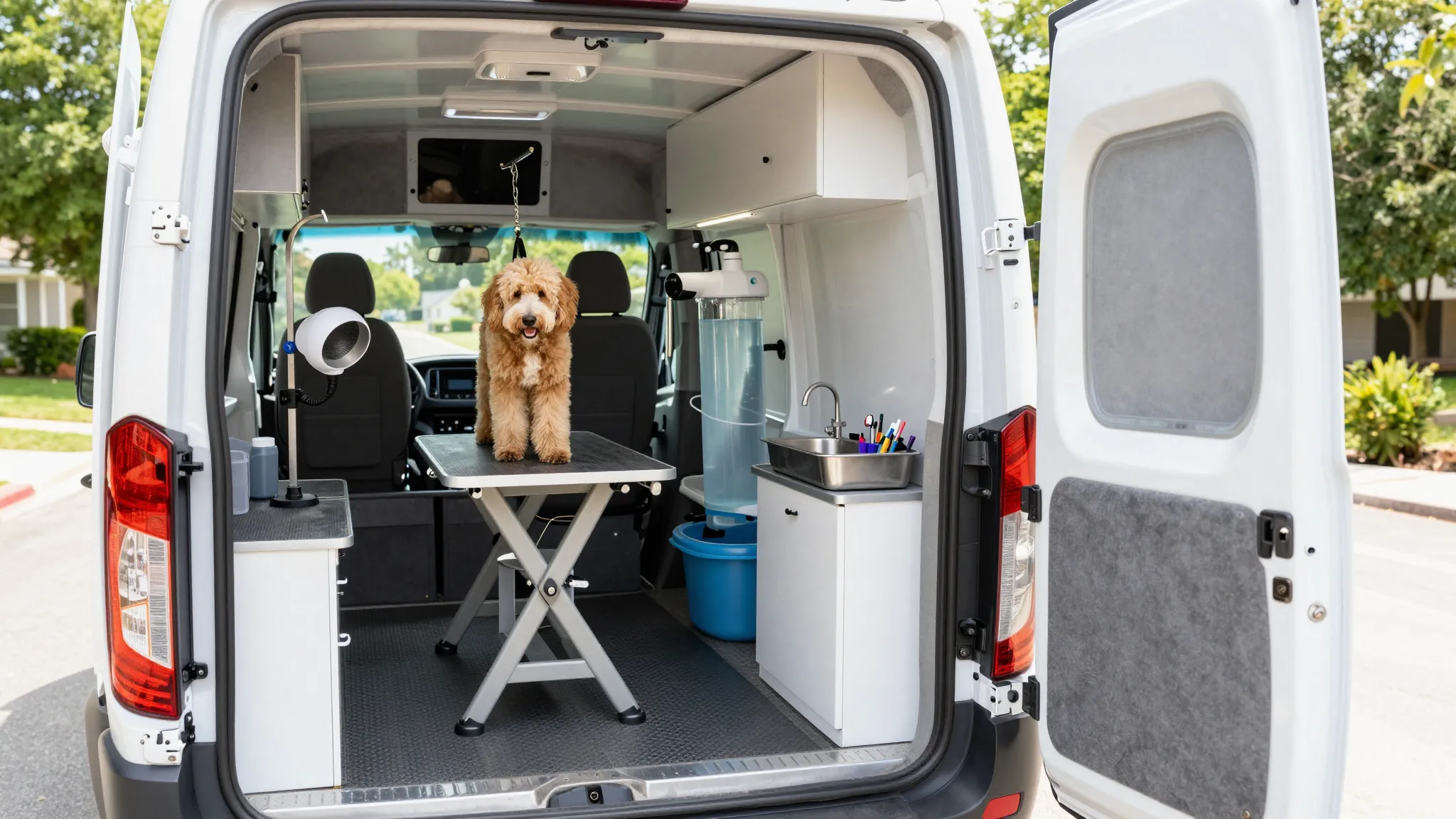
Your van is your entire business. A standard grooming van conversion costs between $15,000 and $45,000 depending on whether you buy a pre-built unit — Hanvey Engineering and Wag'n Tails start around $25,000 — or convert a cargo van yourself. At minimum, your setup needs a 40-gallon fresh water tank, a 60-gallon wastewater tank, a forced-air or hydraulic grooming table, a high-velocity dryer (Flying Pig or K-9 II are industry standards), and a generator or shore power connection for locations without hookups.
Organize your tools in labeled zones — bathing, drying, finishing — so you spend zero time hunting for equipment mid-groom. A magnetic strip on the wall keeps scissors and combs in the same spot every single day. Groomers who optimize their van layout report finishing appointments 10–15 minutes faster per dog, which compounds to one or two additional bookings per day at peak schedule.
2. Plan Your Route to Minimize Dead Miles
Dead miles — driving time between appointments with no revenue — are the silent profit killer for mobile groomers. A well-optimized route groups clients by neighborhood and keeps you moving in one direction, not zigzagging across town. Plan your week in geographic zones: Monday in the north quadrant, Tuesday in the south, and so on. This approach keeps weekly fuel costs under $200 in most mid-size cities versus $350+ for unoptimized routing.
Use Google Maps' multi-stop route feature or a dedicated routing tool like Route4Me to sequence 6–8 appointments per day within a tight area. Buffer 15–20 minutes between each appointment for van cleanup, water changes, and unexpected overruns — a rushed transition is how van groomers earn bad reviews. Never schedule your last appointment of the day more than 30 minutes from your home base; late finishes with a long drive home compound fatigue and increase accident risk.
3. Run a Pre-Shift Equipment Check Every Morning
Equipment failures don't just inconvenience clients — they destroy your day and your reputation. Before leaving home every morning, run a 10-minute checklist: water tank levels (fresh and waste), generator fuel, clipper blade sharpness (dull blades cause clipper burn and client complaints), dryer function, table hydraulics or locking mechanism, and van tire pressure. This 10-minute habit prevents the majority of on-location breakdowns that cost you full-day income.
Keep a mobile tool kit stocked with spare clipper blades in three sizes, a backup trimmer, extra grooming bands, shampoo concentrates (Espree or Chris Christensen are go-to professional brands), and basic first aid for both pets and yourself. A single broken clipper blade mid-groom can mean a half-finished dog and a full refund — a $15 spare blade prevents a $75 loss and a negative review.
Monthly maintenance checklist
- Flush and sanitize the fresh water tank with a white vinegar solution
- Inspect all electrical connections and check generator oil level
- Check grooming table hydraulics for leaks or pressure loss
- Replace or clean high-velocity dryer filters
- Inspect van exhaust and ventilation for carbon monoxide risk
4. Follow a Pet Safety Protocol on Every Visit
A pet injury in your van — even a minor one — can result in a $500–$3,000 vet bill dispute, a 1-star review, and potential loss of your insurance coverage. Before starting any groom, do a visual health check: look for skin lesions, ear infections, matting that could conceal wounds, and signs of respiratory distress or extreme anxiety. If a dog shows clear signs of aggression, you are within your rights to decline the appointment — document it in your client notes and charge a $25–$50 short-notice cancellation fee.
Never leave a dog unattended on a grooming table, even with a grooming loop in place. Grooming loop strangulations are among the leading causes of grooming-related pet injuries and are entirely preventable. Keep a pet first aid kit on board with styptic powder, gauze, saline solution, and an emergency vet contact for each appointment zone you work. Requiring clients to disclose pre-existing health conditions and medications in your intake form before the groom protects you legally and helps you provide safer care on every visit.
5. Build a Scheduling System That Eliminates No-Shows
No-shows hit mobile groomers harder than any other service category. When a salon client no-shows, the groomer is already at work. When your client no-shows, you've burned fuel, 30 minutes of drive time, and blocked that slot from a paying client. One no-show per week at a $90 groom equals $4,680 in lost revenue per year — before you account for wasted fuel and the cost of a rushed reschedule.
The solution is three-part: automated reminders sent 48 hours and 2 hours before each appointment, a card-on-file policy, and the option to require a deposit at booking. Clients who've paid a deposit cancel at a far lower rate than those who haven't — they have financial skin in the game. Manual reminder texts from your personal phone the night before are not a system. They're a liability that breaks the moment your schedule fills and you're too exhausted to remember who's booked for 8 a.m.
6. Track Your Revenue and Fuel Costs Weekly
Most mobile groomers who fail don't fail because they can't groom — they fail because they don't know their numbers. Your three core metrics are: revenue per day, cost per mile (fuel plus maintenance divided by miles driven), and average ticket per appointment. For a solo groomer charging $75–$120 per full groom, a healthy day is 6–7 appointments totaling $450–$840. If your cost per mile exceeds $0.65, your routing needs immediate work.
Track revenue weekly, not monthly. Monthly tracking lets problems compound for four full weeks before you notice them. If you had two slow weeks in a row, you need to know by week two — not at month end when the damage is already done. Look for patterns: Is Tuesday always slower? Are afternoon slots harder to fill? That data tells you exactly where to run a promotion, shift your availability, or open up a new neighborhood zone.
The right tool makes this easier
Running a van-based grooming business means you're the driver, the groomer, the customer service rep, and the bookkeeper — all before noon. The administrative overhead of managing bookings, sending reminders, collecting waivers, and processing payments manually is the reason most solo groomers hit a ceiling around $60,000 in annual revenue and struggle to grow past it.
ROXO Hub is built for exactly this business model. Clients self-book 24/7 from your website — you're not fielding calls while navigating traffic. Auto reminders go out at 48 hours and 2 hours before each appointment without you touching a phone. You can optionally require a deposit at booking, which filters uncommitted clients out of your calendar before they waste a slot. Digital intake forms and waivers are collected before the appointment, so you arrive with signed paperwork already on file — not a clipboard to chase in a client's driveway.
Payments process via tap-to-pay at the van — no card reader required — and you can enable instant payouts so revenue hits your account the same day. At $39.99/month flat with no per-feature add-ons and no percentage taken from your bookings, a groomer doing $4,000–$6,000/month in revenue is spending under 1% of gross to replace the entire admin stack.
Online Booking
Clients self-book 24/7 from your grooming website — no calls while you're on the road.
Auto Reminders
Automated texts reduce no-shows without any manual follow-up from you.
Digital Waivers
Intake forms and consent waivers collected before every appointment.
Tap-to-Pay
Accept cards and Apple Pay at the van — no card reader required.
Frequently Asked Questions
How much does it cost to start a mobile pet grooming van business?
Startup costs range from $20,000 to $55,000 depending on whether you buy a pre-built unit or convert a cargo van yourself. Pre-built conversions from Hanvey Engineering or Wag'n Tails run $25,000–$45,000. A self-converted Sprinter or Transit van can come in at $15,000–$25,000 if you source equipment separately. Add commercial insurance ($150–$300/month), business licensing, and initial grooming supplies to your full startup budget.
How many dogs can a mobile groomer do in a day?
A solo mobile groomer with a well-optimized route can complete 6–8 appointments per day. Each full groom takes 45–90 minutes depending on breed and coat condition, plus 10–15 minutes for van cleanup and driving to the next stop. Most experienced groomers cap at 6 appointments as a sustainable daily maximum to maintain quality and avoid burnout over the long term.
Do I need a special license to run a mobile grooming van?
Requirements vary by state and city, but most jurisdictions require a business license, a mobile grooming permit, and proof of liability insurance. Some states including California and Florida have additional animal handling regulations. Check with your local county clerk and state department of agriculture before operating commercially — penalties for unlicensed operation can include fines and forced closure.
What's the best way to handle no-shows as a mobile groomer?
The most effective no-show prevention combines automated appointment reminders with a card-on-file or deposit policy at booking. Reminders sent 48 hours and 2 hours before the appointment give clients a clear window to reschedule without wasting your drive. Optionally requiring a deposit — even $20–$30 — dramatically reduces last-minute cancellations because the client has already committed financially.
How do I price mobile pet grooming services?
Mobile grooming typically commands a 20–35% premium over salon pricing because of the door-to-door convenience factor. A full groom that costs $60–$80 at a salon generally runs $80–$120 for mobile. Price by breed and coat complexity — a Shih Tzu takes 60–75 minutes; a Standard Poodle takes 90–120 minutes. Factor in your fuel cost per appointment (typically $8–$15 per visit depending on your zone) and target a minimum of $65 gross profit per appointment after all expenses.
What software do mobile pet groomers use to manage bookings?
Mobile groomers need software that handles online booking, automated reminders, digital waivers, and payment processing in one place — managing these separately across multiple apps is unworkable when you're driving between clients. ROXO Hub covers all of these at $39.99/month flat with no per-transaction fees on bookings, making it a practical all-in-one option for solo and small-team van operations.
Stop Losing Revenue to No-Shows
ROXO Hub sends automated reminders and lets you optionally require a deposit at booking — so uncommitted clients don't waste your drive time or your calendar.
Start Your TrialReady to run your pet grooming business smarter?
Setup takes 15 minutes. No contracts. Cancel anytime.
Roali (Roy) Biten
Founder, ROXO Hub
Disclaimer: The content in this article is provided for informational purposes only. ROXO Hub strives to publish accurate and helpful information, but we make no guarantees about the completeness, reliability, or accuracy of the content. Information may change over time and may not reflect the most current developments. Always conduct your own independent research and consult qualified professionals before making business decisions. ROXO Hub is not liable for any errors, omissions, or outcomes resulting from reliance on this content. Terms of Use.