
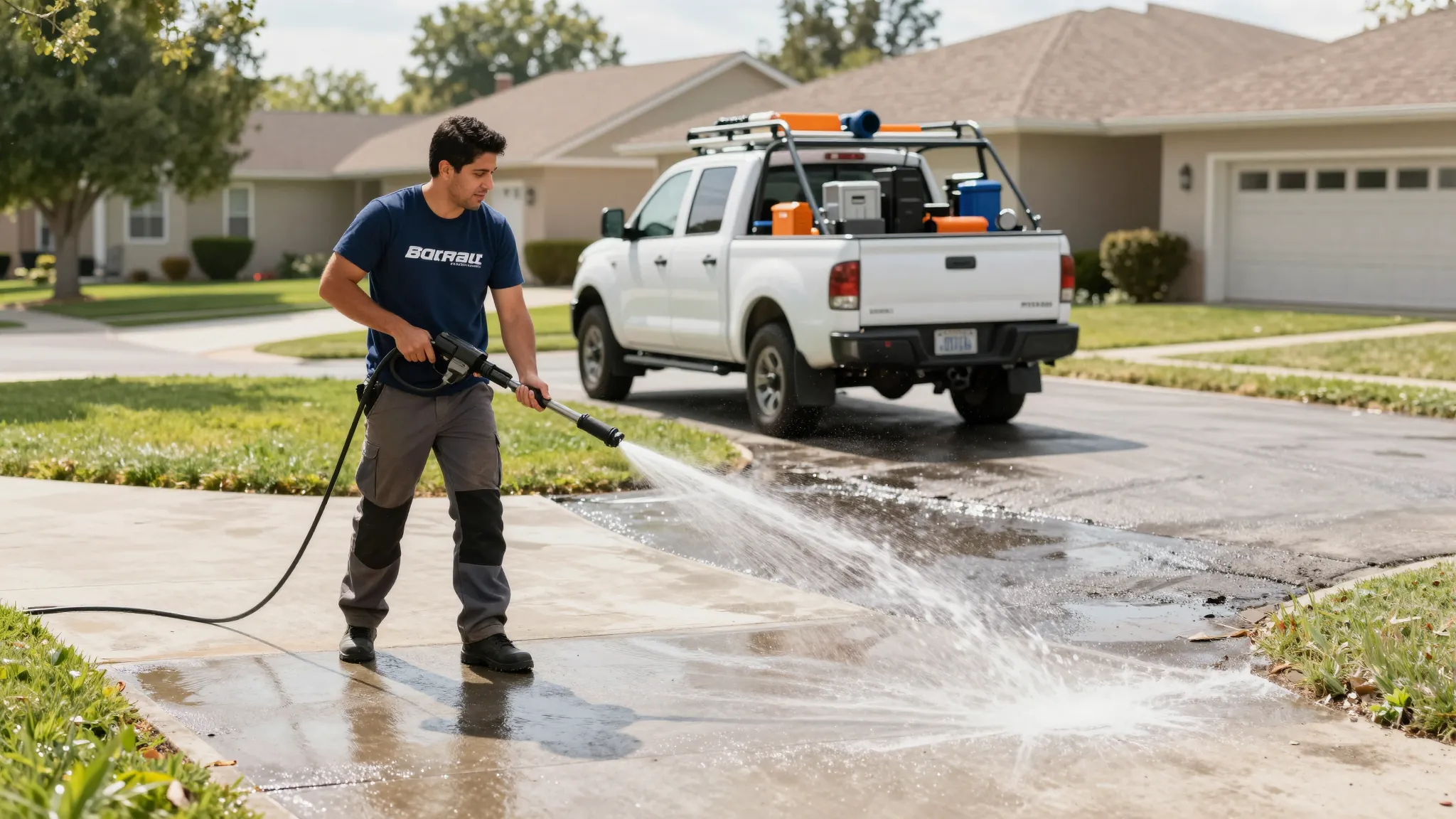
How to Start a Pressure Washing Business in 2026 (Complete Guide)
Roali (Roy) Biten
Founder, ROXO Hub · April 16, 2026
Ready to take bookings from day one?
ROXO Hub gives pressure washing businesses 24/7 online booking, tap-to-pay on your phone, auto reminders, and a built-in website — all for $39.99/month flat, no add-ons.
Start Your TrialIn this article
- 1.Table of Contents
- 2.Why Pressure Washing Is a Strong Business in 2026
- 3.Legal Setup: Business Structure, Licenses and Permits
- 4.Equipment You Need to Start (and What to Skip)
- 5.Realistic Startup Cost Breakdown
- 6.How to Price Pressure Washing Jobs in 2026
- 7.Insurance: What You Need and What It Costs
- 8.How to Get Your First Pressure Washing Clients
- 9.Managing Bookings, Payments and Clients
- 10.Building Your Online Presence as a Pressure Washer
- 11.Scaling Your Pressure Washing Business Beyond Solo
- 12.The Right Tool Makes This Easier
- 13.Frequently Asked Questions
How to Start a Pressure Washing Business in 2026 (Complete Guide)
A solo pressure washing operator running 4–5 jobs per day, five days a week, can gross $150,000–$200,000 annually — yet most people who attempt this quit within 12 months because they treat it like a gig instead of building it like a business. The equipment is learnable in a weekend, and the chemistry takes a few weeks to master. What actually destroys new pressure washing businesses is the back office: no-shows eating the schedule, unpaid invoices, zero online presence, and pricing pulled from thin air that leaves $40–$60 per job on the table. This guide covers every step to launch, price, and run a profitable solo pressure washing business in 2026 — from your first equipment purchase through the digital infrastructure that keeps your calendar full without cold calls.
Why Pressure Washing Is a Strong Business in 2026
The fundamentals are simple: property owners spend real money keeping concrete, siding, roofs, and decks clean — and they hire out because they don't own the equipment and don't want to spend their Saturday doing it. What has changed in 2026 is how easy it is to reach those customers digitally, process payments on-site without a card reader, and run a professional one-person operation that competes with established companies from day one.
Revenue benchmarks for a solo operator running standard residential and light commercial work:
- Residential driveway (800–1,500 sqft): $120–$220 per job
- House washing (exterior soft wash): $200–$500 depending on square footage
- Roof soft washing: $300–$700 depending on pitch and size
- Concrete flatwork (commercial parking): $500–$2,500
- Deck cleaning and brightening: $200–$450
- Storefront or commercial building wash: $300–$1,200
At an average of $200 per job and 4 jobs per day, you're generating $800/day — roughly $200,000/year at 5 days a week, 50 weeks. After truck expenses, equipment, chemicals, insurance, and software, a well-run solo operation can produce $80,000–$120,000 in net profit. Low overhead is the defining advantage. You don't need a storefront, employees, or expensive inventory. A truck, a machine, chemicals, and a phone are enough to build a six-figure operation. The businesses that fail usually overspend on equipment before building a client base, underprice their work, or skip the professional booking and payment tools that turn one-time customers into recurring revenue.
Legal Setup: Business Structure, Licenses and Permits
Before you take a single job, get your legal structure in place. Skipping this step exposes your personal assets if a client claims property damage — and in pressure washing, property damage claims happen. A cracked window from water pressure or stripped siding from an incorrect nozzle choice can cost $500–$5,000 to resolve.
Choose your business structure
Most solo pressure washers start as a sole proprietor and convert to an LLC (Limited Liability Company) within the first year. An LLC costs $50–$500 to form depending on your state and separates your personal finances from business liability. Services like ZenBusiness ($49 one-time) or LegalZoom ($79+) file your LLC online in one day. Once formed, get an EIN (Employer Identification Number) from the IRS — it's free and takes 10 minutes at irs.gov. You'll need this to open a business bank account.
Business license
Most cities and counties require a general business license to operate. Cost is typically $50–$150/year. Check your county clerk's website or your city's online business portal. Some jurisdictions process these same-day; others take 2–4 weeks by mail.
State contractor license
Some states — including Florida, California, and Georgia — require a specialty contractor license for exterior cleaning services. Others require nothing beyond a general business license. Look up your state's requirements through your Department of Business and Professional Regulation, Department of Consumer Affairs, or equivalent licensing agency before accepting paid work.
DBA registration
If you operate under a business name other than your personal name — like "Precision Pressure Washing" — file a DBA (Doing Business As) with your county clerk. Cost is typically $25–$50. This allows you to open a business bank account and accept checks made out to your business name.
EPA and water discharge regulations
This is the compliance area most new pressure washers ignore — and it can lead to significant fines. When you pressure wash a driveway or parking lot, wastewater containing detergents and oil residue cannot legally flow into storm drains in most jurisdictions under the Clean Water Act. Best practice: use a surface cleaner with a vacuum recovery attachment to capture wastewater on commercial jobs, or divert residential runoff to a grassy area or permeable surface away from storm drains. Commercial clients often require documentation that you have a wastewater management plan before awarding a contract.
Equipment You Need to Start (and What to Skip)
You do not need a $15,000 rig to start. A $1,500–$3,500 setup handles 80% of residential work and most light commercial jobs. The key is knowing which pieces are essential versus nice-to-have.
Cold water vs. hot water machines
Cold water machines handle driveways, house washing, concrete cleaning, decks, and most residential surfaces. Hot water machines — starting at $3,500 — break down oil, grease, and gum faster, which is valuable for commercial work like restaurant drive-throughs and parking garages. Start cold unless you're targeting commercial accounts from day one. You can always add a hot water machine later when the revenue justifies it.
Recommended cold water machines:
- Simpson Cleaning PS3228-S (3,200 PSI, 2.8 GPM): $400–$500. Reliable Honda GX270 engine. Good entry-level unit for residential work.
- BE Power Equipment B4013HBS (4,000 PSI, 4.0 GPM): $700–$900. Professional-grade with longer run time between refuels. Good for operators doing 4+ jobs per day.
- Pressure-Pro E4040HC (4,000 PSI, 4.0 GPM): $1,200–$1,500. Built for daily commercial use. Fully stainless frame, direct drive pump.
Recommended hot water machine when you're ready to scale:
- Landa PHW Series (3,000 PSI): $4,500–$6,000. Standard workhorse for commercial pressure washing accounts.
Surface cleaner (non-negotiable)
A surface cleaner — a rotating dual-jet spray bar inside a circular housing — cuts driveway cleaning time in half versus a single wand and eliminates the stripe marks that wand-only work leaves on concrete. Without one, you'll lose bids to operators who can quote faster jobs and deliver cleaner results. The General Pump EZ-Glide 18-inch (~$200) and the NorthStar 21-inch surface cleaner (~$350) are both solid choices for residential and light commercial work.
Remaining essentials
- 200-ft MTM Hydro hose reel: $150–$200
- Suttner ST-2300 spray gun and wand: $80–$120
- Nozzle set (0°, 15°, 25°, 40°, and soap/downstream): $30–$50
- Downstream chemical injector: $20–$30
- 12V soft wash pump (for applying sodium hypochlorite on house and roof washes): $60–$120
- 5-gallon chemical jugs for SH, degreaser, and neutralizer: purchased ongoing at $15–$30/jug from a janitorial supply
What to skip at launch
Hold off on a trailer setup, hot water machine, roof climbing equipment, and specialty flatwork vacuums until you have consistent monthly revenue. Trailers add maneuverability challenges on residential streets before you've optimized your routes, and they require a trailer hitch, registration, and insurance endorsement. Build the cash flow first.
Realistic Startup Cost Breakdown
Here is a realistic three-tier budget for a solo pressure washing launch. These numbers assume you already own a truck. If you need to buy one, add $8,000–$25,000 depending on condition and year.
| Item | Budget Launch | Mid-Range | Pro Setup |
|---|---|---|---|
| Pressure washer | $450 | $850 | $1,500 |
| Surface cleaner | $200 | $300 | $400 |
| Hoses, gun, wand, nozzles | $150 | $250 | $400 |
| 12V soft wash pump + injector | $80 | $120 | $200 |
| Starting chemical inventory | $100 | $200 | $350 |
| LLC formation | $50 | $150 | $200 |
| Business license | $75 | $100 | $150 |
| General liability insurance (year 1) | $600 | $800 | $1,200 |
| Business management software (ROXO Hub) | $40/mo | $40/mo | $40/mo |
| Marketing (door hangers + initial digital) | $200 | $400 | $800 |
| Total one-time startup | ~$1,905 | ~$3,170 | ~$5,200 |
The budget-level setup is fully capable of handling residential driveways, house washes, and deck cleaning. The mid-range setup adds reliability and capacity for operators who want to do 4–5 jobs per day from month one. The pro setup is for operators targeting commercial accounts from launch.
How to Price Pressure Washing Jobs in 2026
Pricing is where most new pressure washers leave money on the table — either undercharging to win bids or quoting inconsistently because there's no system. The fix is a clear pricing structure you can quote in 90 seconds without second-guessing.
Set a minimum job charge first
Never drive to a job for less than $125. At lower rates, your drive time, setup, and breakdown make the job unprofitable before you spray a drop. Most operators working in mid-size and large markets set their minimum at $150–$175. If a job doesn't hit your minimum, quote the minimum and let the client decide.
Per-square-foot pricing for flatwork
- Light residential concrete (low staining): $0.15–$0.20/sqft
- Moderately stained concrete (mild mildew, tire marks): $0.20–$0.28/sqft
- Heavy staining — oil, rust, paint overspray (add surcharge): $0.30–$0.50/sqft
A 1,000 sqft driveway at $0.18/sqft = $180. Solo time to complete with a surface cleaner: 45–60 minutes including setup and rinse. That's $180–$240/hour equivalent — well above what most hourly workers earn.
House washing (soft wash pricing)
- Up to 1,500 sqft exterior: $150–$250
- 1,500–2,500 sqft: $250–$400
- 2,500–4,000 sqft: $400–$600
- Add $50 for two-story, $100 for three-story
- Add $75–$150 for gutter exterior cleaning same visit
Roof soft washing
- Up to 1,200 sqft: $300–$400
- 1,200–2,000 sqft: $400–$600
- 2,000+ sqft: $600–$900
Roof washing carries higher liability than flat concrete work — always soft wash shingles (low pressure + chemical treatment), never pressure wash them, and photograph the roof condition before and after every job.
Fences and decks
- Wood fence cleaning: $0.75–$1.50 per linear foot
- Vinyl fence: $0.50–$1.00 per linear foot
- Deck cleaning (pressure wash only): $0.25–$0.40/sqft
- Deck clean and brighten (chemical treatment): $0.40–$0.65/sqft
Commercial flatwork
- Parking lots (standard light commercial): $200–$800
- Storefront sidewalk cleaning: $100–$350
- Drive-throughs (requires hot water + wastewater containment plan): $350–$700
- Apartment complex walkways and breezeways: $500–$2,500 depending on linear footage
When to charge more
Add a same-day or next-day urgency surcharge of 15–25% for rush bookings. Add distance fees for jobs 30+ miles from your base. Charge more for gated communities with extended access procedures, jobs requiring chemical dwell time exceeding 30 minutes, or work during extreme heat where chemical concentration drops faster. These aren't nickel-and-diming — they're legitimate cost factors that experienced operators account for in every quote.
Bundling to raise your average ticket
A client who calls for a driveway wash is often open to adding a house wash or gutter exterior clean in the same visit when the offer is made clearly at quote time. A driveway + house wash bundle at $350 beats two separate $180 and $250 visits because you've already driven there and set up. Bundling increases revenue per day without adding a second drive.
Insurance: What You Need and What It Costs
Without insurance, one property damage claim can erase months of profit and expose your personal assets if you're operating as a sole proprietor. A window cracked by water pressure, vinyl siding stripped by an incorrect nozzle, or a vehicle dented by a hose reel costs real money — and clients will pursue claims.
General liability insurance (required)
Covers property damage and bodily injury claims. Minimum coverage for a solo pressure washing operator: $1M per occurrence / $2M aggregate. Expect to pay $500–$900/year. Recommended providers:
- Next Insurance: Instant online quotes, same-day coverage. Most solo operators pay $55–$80/month ($660–$960/year). Built specifically for service contractors, with digital COI delivery in minutes from their app.
- Thimble: Pay-by-the-job or monthly billing. Good for part-time operators ramping up before committing to an annual premium.
- PURE Risk Management / Kinsale: Worth quoting for operators above $100K annual revenue who want broader coverage terms.
Commercial auto insurance
If your truck is used for business operations, your personal auto policy likely excludes business use. A commercial auto endorsement or standalone commercial auto policy adds $100–$300/year to your vehicle insurance. Most general liability carriers can bundle this or refer you to a partner carrier.
Inland marine / equipment floater
Protects your pressure washer, surface cleaner, and ancillary equipment from theft and damage while in transit or at a job site. Most GL carriers offer this as a rider for $100–$200/year. A $2,000 machine stolen from an unsecured truck bed is a painful loss — this coverage pays for replacement within days.
How to Get Your First Pressure Washing Clients
You don't need a large ad budget to land your first 20 clients. You need a combination of local visibility tactics and a professional booking setup that converts interest into confirmed appointments — not phone tag.
Google Business Profile
Create your Google Business Profile at business.google.com. It's free. Add photos of your equipment and completed work, set your service area to a 15–25 mile radius, list every service with descriptions, and ask every satisfied client for a review immediately after the job. A profile with 10+ reviews and complete service categories begins appearing in Google Maps results for searches like "pressure washing near me" and "driveway cleaning [city]." This is your highest-ROI long-term channel — start building it from your first completed job.
Door hangers
Print 500 door hangers at Canva Print or VistaPrint for $40–$70. Target a tight geographic zone — 200 homes in a 3-block radius where driveways visibly need cleaning. Include a simple booking link (your ROXO Hub booking page URL) so interested homeowners can self-schedule instead of waiting for a call back. Expect a 1–3% response rate, which translates to 5–15 inbound inquiries from 500 hangers in a responsive neighborhood.
Facebook and Nextdoor neighborhood groups
Join the Facebook neighborhood groups and Nextdoor communities for every zip code in your service area. Post before/after photos — always ask client permission before posting their property. Authentic before/afters in local community feeds regularly generate 20–50 inquiries in cities with active neighborhood groups, and the audience is entirely local by definition.
Thumbtack and Angi
Both platforms charge per lead — $10–$45/lead for pressure washing depending on job size and your market. Useful during the first 90 days while your Google reviews build. Budget $100–$200/month and expect 2–4 booked jobs per month from these sources. Once your GBP has 15+ reviews, inbound organic leads will start replacing paid platform leads.
Realtor partnerships
Real estate agents routinely need exterior cleaning done quickly before listing photos. A clean driveway and house exterior can increase perceived curb appeal in listing photos enough to justify the expense to sellers. Contact active realtors in your market directly via LinkedIn or in person at open houses. Two or three realtor relationships generating one job per month each adds $500–$1,000/month in consistent referral revenue.
Instagram and TikTok content
Pressure washing content performs exceptionally well on both platforms — the transformation is visually satisfying, shareable, and hyperlocal. Record every job, post the best before/after clips 3× per week, and use location hashtags (#[CityName]PressureWashing, #[CityName]HomeServices). Link your ROXO Hub booking page in your bio. Organic reach from local hashtags in a 100K-population city generates consistent inbound DMs within 60 days of regular posting, at zero ad spend.
Managing Bookings, Payments and Clients
Running a pressure washing business on text messages and Venmo is how you lose revenue, miss rebooking opportunities, and burn out. When you're on a job, you can't answer calls. When you're driving between jobs, you can't respond to DMs. When you're chasing invoices, you're not doing billable work. The operators who build consistent $150K+ revenue don't work more hours — they build systems that work when they can't.
The purpose-built solution for solo service operators is ROXO Hub at $39.99/month flat. No per-feature pricing. No transaction fees on top of processing. No bolt-together of five separate tools. Here's what it handles for a pressure washing business specifically:
24/7 Online Booking
Clients book directly from your ROXO Hub website while you're on a job. No calls, no back-and-forth texts, no leads lost while your hands are wet.
Auto Reminders
ROXO Hub sends automated appointment reminders before every job, so clients don't forget and no-shows drop without any manual effort on your part.
Tap-to-Pay
Accept cards and Apple Pay on-site directly from your phone — no card reader hardware required. Hand your phone to the client or tap theirs.
Instant Payouts
Get paid the same day you complete a job, directly to your bank account. No waiting 3–5 business days for payment to clear.
Invoicing
Send professional invoices for commercial accounts that pay on net-15 or net-30 terms. Track outstanding balances and revenue in one place.
No-Show Protection
Optionally require a deposit at booking or store a card on file — you choose whether to enable it for each booking type. When a client puts money down, uncommitted clients self-select out before wasting a slot.
ROXO Hub also includes a built-in website builder — your professional booking page is live in 15 minutes, included in the $39.99/month subscription. There is no separate Wix or Squarespace subscription to pay for. The website, booking, payments, client records, and marketing tools are all in one platform. Clients book directly from your website — they do not need to download any app to do so. You manage everything from ROXO Hub's own mobile app.
For client management, ROXO Hub stores notes, job history, and past invoices for every client. When a homeowner calls back 8 months later for a pre-sale house wash, you can pull up their record instantly — what you charged last time, what surfaces you cleaned, any notes about site access or a gate code — without digging through a text thread.
For marketing, ROXO Hub's built-in tools let you run follow-up campaigns, send seasonal promos to past clients, and collect 5-star reviews automatically after each completed appointment. A client review prompt sent within 2 hours of job completion generates significantly more responses than asking in person at the end of the job.
You can also explore how other operators use ROXO Hub's scheduling and payment tools in our guide to best apps for pressure washing businesses in 2026.
Building Your Online Presence as a Pressure Washer
A professional online presence in 2026 does two things: it makes you findable when someone searches for pressure washing in your area, and it makes you hireable when they find you. A sloppy or absent online presence loses you jobs to competitors who are no better operators but simply look more legitimate online.
Your website
Your ROXO Hub website is your digital home base. It lists your services, shows your work through photos, and has a Book Now button that takes clients directly into your booking calendar. Every marketing touchpoint — door hangers, social bios, business cards, vehicle magnets — should point to this URL. Keep the photos updated monthly with new project work. A website showing 12-month-old photos signals a business that may not be active.
Google Business Profile (weekly activity matters)
Post to your GBP weekly — project photos, before/afters, seasonal promotions, or simple updates about your service area. Google's local algorithm rewards active profiles with better Local Pack placement (the map results that appear above organic search results). A profile with 25+ reviews and weekly posts consistently outranks newer or inactive competitors in most mid-size markets.
Collecting reviews systematically
ROXO Hub's client review tools automatically prompt clients for a review after each appointment. A text or email that says "Thanks for booking — if you're happy with the results, a quick Google review helps us a lot: [link]" sent within 2 hours of job completion works far better than asking in person. Reviews compound: the business with 40 reviews at a 4.9 star average wins the click over the business with 8 reviews at 5.0 almost every time because volume signals reliability.
Instagram and TikTok for local organic reach
Create a simple content routine: film every job, post the best before/after 3× per week with location tags. Respond to every comment and DM within 2 hours during your first 90 days. Consistent posting builds a local audience that converts to bookings — people who've seen your work for weeks before they need it are far more likely to book you than someone who found you in a cold search. Detailed guidance on growing client volume is in our post on how to get more pressure washing clients.
Yelp and Facebook Business
Secondary to Google but worth maintaining. Create profiles, add photos, keep your phone number and booking link current, and respond to every review — positive or negative. A business that visibly responds to reviews signals that it pays attention to customer experience.
Scaling Your Pressure Washing Business Beyond Solo
Once you're consistently booked 3–4 weeks out and turning away work, you have two options: raise prices, or add capacity. The right answer is almost always to raise prices first.
Step 1: Test a price increase before hiring
Before adding labor costs, test a 10–15% price increase on new bookings. If you retain 85%+ of clients at the new rate, your pricing was below market and the increase flows directly to your net profit. Many solo operators find they can raise average job prices $25–$50 before encountering meaningful pushback — which often generates more additional annual income than hiring a helper at $18–$22/hour and managing their schedule, quality, and payroll.
Step 2: Add a helper before a second rig
Hiring a part-time helper ($18–$22/hour) lets you run two-person crews that complete 6–7 jobs per day versus 4–5 solo. You keep the existing equipment investment and test the employer experience without buying a second truck and machine. Pay helpers as W-2 employees, not 1099 contractors, if they're working regular hours under your direction — the IRS classification test is strict and misclassification carries back-tax liability.
Step 3: Add a second rig
When a helper is consistently generating more in additional revenue than their hourly cost, a second setup makes economic sense. Budget $6,000–$15,000 for a used truck setup (truck, machine, surface cleaner, hoses, chemicals). The second operator runs their own route under your brand, using your ROXO Hub scheduling calendar which shows both operators' schedules simultaneously.
Step 4: Build recurring commercial contracts
Residential jobs produce higher per-job margins but are seasonal in cold climates and require constant lead generation. Commercial accounts — HOA communities, strip malls, apartment complexes, restaurant chains — often sign monthly or quarterly maintenance contracts worth $500–$3,000/month per account. Five commercial maintenance contracts can generate $3,000–$10,000/month in predictable recurring revenue alongside your residential business. This is where the long-term stability in pressure washing lives. For a detailed breakdown of how to land commercial contracts and price recurring packages, see our guide to pressure washing pricing in 2026.
Step 5: Systemize everything
When you're managing a team, your business runs on documented processes — job checklists, chemical dilution ratios, client communication scripts, pricing calculators. ROXO Hub's scheduling calendar shows your whole team's week at a glance, client notes travel with every appointment, and payments and invoices are tracked centrally whether you're the one completing the job or an employee is. Reports and analytics show which services and which neighborhoods are producing the most revenue, so you can double down on what's working.
The Right Tool Makes This Easier
Every stage of building a pressure washing business — from your first driveway job to managing a crew of three — requires back-office infrastructure that works while you work. ROXO Hub is built specifically for solo and small-team service businesses. Online booking that runs 24/7, tap-to-pay that processes cards on the spot with no hardware, automatic reminders that reduce no-shows, same-day payouts, and a built-in website — all for $39.99/month flat. No contract, no per-feature pricing, no need to bolt together five separate subscriptions.
If you're starting from scratch in 2026, the infrastructure question is straightforward: build your business on tools designed for service operators, not tools designed for retail stores or enterprise teams. The operators who scale past $200K solo do so because they spend their time on billable work, not on scheduling calls, chasing invoices, or manually following up on reviews.
Frequently Asked Questions
Do I need a license to start a pressure washing business?
Most states don't require a specialty license for pressure washing — a general business license ($50–$150/year from your city or county) is typically sufficient. However, states including Florida, California, and Georgia have specific contractor licensing requirements, so check your state's business regulation agency before accepting paid work.
How much does it cost to start a pressure washing business?
A solid solo setup — machine, surface cleaner, hoses, chemicals, LLC formation, business license, and first-year insurance — runs $1,900–$5,200 before vehicle costs. If you already own a capable truck, you can be fully operational for under $3,000 at the mid-range level.
How do pressure washing businesses get clients?
The most effective channels for new operators are Google Business Profile (build reviews from day one), door hanger campaigns in targeted neighborhoods ($40–$70 per 500 hangers), Facebook and Nextdoor local groups, and before/after content on Instagram and TikTok. A professional booking link in all of these touchpoints converts interest into confirmed appointments without phone tag.
What PSI do I need for pressure washing?
For residential driveways, concrete, and siding, a 3,000–4,000 PSI machine handles the full range of jobs. Roof washing uses low-pressure soft wash (under 500 PSI) with chemical treatment — never high pressure on shingles. Commercial jobs involving grease and oil benefit from 3,000+ PSI hot water units.
How much should I charge for pressure washing a driveway?
A standard residential driveway (1,000–1,500 sqft) typically runs $150–$250 in most US markets in 2026. Price at $0.15–$0.25/sqft depending on staining level, with a minimum job charge of $125–$150 regardless of size. Never price below your minimum — drive time and setup are costs even on small jobs.
Is pressure washing a profitable business?
Yes — a solo operator running 4 residential jobs per day at an average of $200 per job grosses roughly $200,000/year at full capacity. After operating expenses (truck, fuel, chemicals, insurance, software), net profit for a well-run solo operation typically runs $80,000–$120,000/year. Margins improve further when recurring commercial contracts replace one-time residential jobs.
What insurance do I need for a pressure washing business?
At minimum, a $1M/$2M general liability policy ($500–$900/year through carriers like Next Insurance or Thimble). If your truck is used for business operations, add a commercial auto endorsement. An equipment floater protecting your machine from theft adds roughly $100–$200/year as a rider on your GL policy.
Can I pressure wash as a side hustle?
Yes, and many operators start part-time — weekends and evenings — before going full-time. Thimble's pay-per-job insurance is useful for part-time operators who don't want to pay annual premiums. ROXO Hub's online booking means clients can self-book around your availability without you needing to be available by phone during your day job hours.
Do I need an LLC for a pressure washing business?
You don't legally need one to start, but an LLC separates your personal assets from business liability and costs only $50–$500 to form. Given that pressure washing involves being on client properties with equipment that can cause property damage, the liability protection is worth the small formation fee. Most operators form an LLC within the first 90 days.
How do I price a house wash?
Price house washing based on square footage of the exterior surface: $150–$250 for homes under 1,500 sqft, $250–$400 for 1,500–2,500 sqft, and $400–$600 for 2,500–4,000 sqft. Add $50 for two-story access and $75–$150 for gutter exterior cleaning in the same visit. Always use soft wash (low pressure + SH-based chemical) on siding — high pressure can force water behind panels and cause moisture damage.
What chemicals do pressure washers use?
The core chemicals are sodium hypochlorite (SH) for biological growth (mold, algae, mildew) on roofs, siding, and concrete; a degreaser for oil and grease staining; a concrete brightener (oxalic or phosphoric acid) for rust and oxidation; and a neutralizer to balance pH after SH applications. Dilution ratios vary by surface and staining level. Source chemicals from a local janitorial supply or chemical distributor — not from hardware store retail jugs, which are too dilute and too expensive per gallon for professional use.
How do I get commercial pressure washing contracts?
Direct outreach to property managers, HOA management companies, and commercial real estate firms is the most efficient path. Show up to a commercial property, photograph the current condition of the concrete, and email the property manager a quote with before photos and your Certificate of Insurance. Commercial clients require a COI before signing — have yours ready to send digitally. Price commercial maintenance contracts at a slight discount versus one-time rates in exchange for volume and scheduling predictability.
What's the difference between pressure washing and soft washing?
Pressure washing uses high-pressure water (2,500–4,000 PSI) to mechanically remove dirt, grime, and staining — best for concrete, brick, and stone. Soft washing uses low pressure (under 500 PSI) with chemical treatment (typically SH-based) to kill and remove biological growth on surfaces that can't tolerate high pressure — roofs, painted siding, wood fences, and stucco. Most professional operators do both, since house and roof washing almost always require soft wash technique.
How do I handle wastewater runoff legally?
Storm drain discharge of wash water containing detergents, oil, or other contaminants is regulated under the Clean Water Act in most jurisdictions. On commercial jobs, use a surface cleaner with a vacuum recovery attachment to capture wastewater. On residential jobs, divert runoff to a grassy or permeable area away from curbs and storm drain openings. Check with your city's stormwater management department for specific local requirements — regulations vary significantly by municipality.
How do I take deposits for pressure washing jobs?
ROXO Hub lets you optionally enable deposit collection at booking — you set the amount (flat fee or percentage) and the system collects it when the client completes their booking. Enabling deposits for new residential clients removes uncommitted bookings from your calendar before they become no-shows. You choose whether to require deposits, and for which service types — it's not automatic on every booking unless you configure it that way.
What's the best software for managing a pressure washing business?
ROXO Hub ($39.99/month) is purpose-built for solo and small-team service operators and handles online booking, client management, tap-to-pay, invoicing, auto reminders, same-day payouts, and a built-in website in one flat-rate platform. It eliminates the need to bolt together separate scheduling, payments, and marketing tools. For a broader comparison of apps in this space, see our best apps for pressure washing businesses guide.
How do I set up online booking for pressure washing?
ROXO Hub includes an online booking system and a built-in website as part of its $39.99/month subscription. Your booking page is live within 15 minutes of setup. Add the URL to your Google Business Profile, social media bios, door hangers, and any other marketing so clients can self-schedule 24/7 without calling you — including while you're on a job.
How much can a pressure washing business make per year?
A solo operator working full-time (4–5 jobs/day, 5 days/week) with average job rates of $180–$220 can gross $150,000–$200,000+ per year. Net profit after vehicle, fuel, chemicals, insurance, and software typically runs $75,000–$120,000 for a well-managed solo business. Operators who add commercial maintenance contracts and recurring residential accounts can reach $250,000+ gross with a small crew.
What equipment do I need to start pressure washing?
The essential starting kit: a 3,000–4,000 PSI cold water pressure washer ($400–$900), a surface cleaner ($200–$350), 200ft of hose with a reel ($150–$200), spray gun and wand ($80–$120), a nozzle set ($30–$50), a downstream chemical injector ($25), and a 12V soft wash pump ($60–$120). Total equipment investment at the budget level: $945–$1,765. A capable truck you already own handles the transport.
How do I market a pressure washing business locally?
The highest-ROI channels in order: (1) Google Business Profile with consistent review collection, (2) before/after content on Instagram and TikTok with local hashtags, (3) door hanger campaigns in targeted neighborhoods, (4) Facebook and Nextdoor neighborhood group posts, and (5) Thumbtack and Angi for paid leads during the first 90 days. All marketing should point to a professional booking page — ROXO Hub's included website makes this easy to set up from day one.
When should I hire help for my pressure washing business?
When you're consistently turning away work and booked 3+ weeks out, it's time to scale — but test a price increase first. If raising rates 10–15% retains the majority of your clients, your pricing was below market and the revenue gain costs nothing. If you're still turning away work after a price increase, hire a part-time helper before investing in a second truck and full equipment rig.
How do I prevent no-shows for pressure washing jobs?
ROXO Hub sends automated reminders before every appointment — reducing the chance a client simply forgets about their booking. You can also optionally enable a deposit requirement at booking: when clients put money down, they have a financial stake in showing up. You control whether deposits are required and for which service types, so you can apply them to new clients or larger jobs without requiring them across every booking type.
Stop chasing invoices and no-shows.
ROXO Hub lets clients book and pay online, sends automatic reminders before every job, and deposits money the same day you complete the work — for $39.99/month.
Try ROXO HubReady to run your pressure washing business smarter?
Setup takes 15 minutes. No contracts. Cancel anytime.
Roali (Roy) Biten
Founder, ROXO Hub
Disclaimer: The content in this article is provided for informational purposes only. ROXO Hub strives to publish accurate and helpful information, but we make no guarantees about the completeness, reliability, or accuracy of the content. Information may change over time and may not reflect the most current developments. Always conduct your own independent research and consult qualified professionals before making business decisions. ROXO Hub is not liable for any errors, omissions, or outcomes resulting from reliance on this content. Terms of Use.