
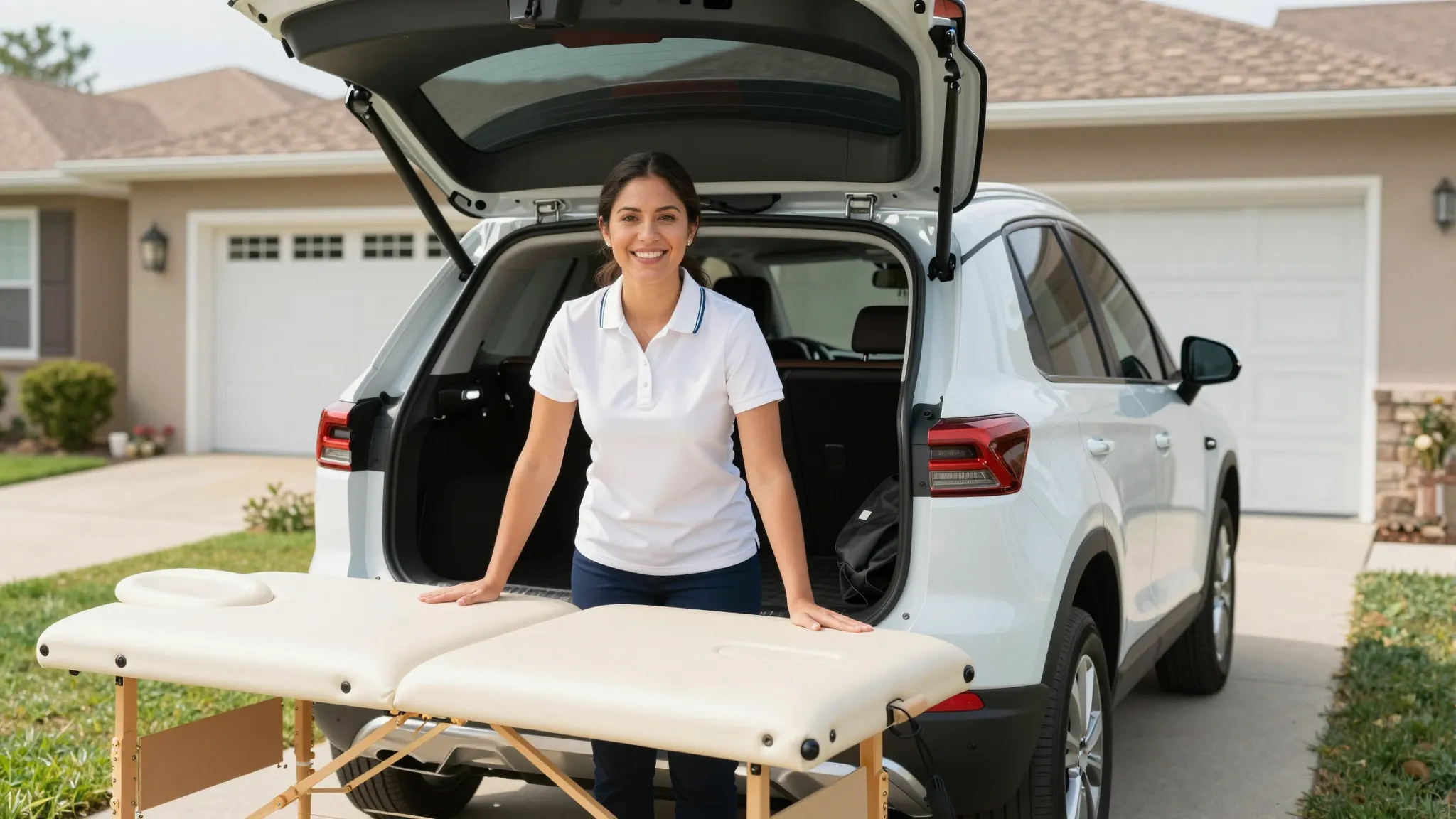
How to Start a Mobile Massage Business in 2026 (Complete Guide)
Roali (Roy) Biten
Founder, ROXO Hub · April 12, 2026
Run your mobile massage business from one platform
ROXO Hub gives you 24/7 online booking, digital intake forms, tap-to-pay, instant payouts, and a built-in website — all for $39.99/month flat.
Start Your TrialIn this article
- 1.Is Mobile Massage the Right Move for You?
- 2.Step 1: Get Licensed and Meet All Legal Requirements
- 3.Step 2: Register Your Business
- 4.Step 3: Get the Right Insurance Before You Book Anyone
- 5.Step 4: Buy Your Equipment (Full Startup Cost Breakdown)
- 6.Step 5: Set Your Pricing for Maximum Profitability
- 7.Step 6: Build Your Brand and Online Presence
- 8.Step 7: Find Your First Mobile Massage Clients
- 9.Step 8: Set Up Your Booking and Payment System
- 10.The Right Tool Makes This Easier
- 11.Step 9: Scale Your Mobile Massage Business Beyond Solo
- 12.Frequently Asked Questions
How to Start a Mobile Massage Business in 2026
Massage therapists at spas and clinics typically earn $18–$28 per hour — but the same 60-minute session delivered in a client's home bills at $100–$135, with a travel surcharge on top. Thousands of therapists are leaving employment to build mobile practices that give them full control over their schedule, pricing, and income. This guide covers every step to launch: licensing, equipment costs, insurance, pricing, finding your first clients, and setting up the booking infrastructure a professional mobile practice requires in 2026.
Is Mobile Massage the Right Move for You?
The financial upside is real: 4–5 sessions per day at $120 each, four days a week, puts you at $8,000–$10,000/month in gross revenue — with no rent, no commission split, and no manager setting your schedule. But mobile work is physically harder than clinic work. You carry a 25–35-pound table to every appointment, handle your own setup and teardown, and build every client relationship from scratch through marketing and referral rather than walk-in traffic.
Before investing in equipment, be honest about two things: your willingness to actively market your business, and your ability to absorb a 3–6 month ramp period before your calendar fills consistently. Therapists who plan for the slow start and treat marketing as part of the job from day one are the ones who reach full-time mobile income within their first year.
Step 1: Get Licensed and Meet All Legal Requirements
Operating without a valid massage therapy license is illegal in 46 of 50 U.S. states — and that applies to in-home sessions, not just clinic work. Most states require 500–1,000 hours of accredited education and a passing score on the MBLEx (Massage & Bodywork Licensing Examination), which costs $265 to sit. State thresholds vary: New York and Nebraska require 1,000 hours; California, Florida, and Texas require 500. Verify your state's exact requirements at the Federation of State Massage Therapy Boards (FSMTB) website, which links directly to every state board.
Even with a valid LMT license, most cities and counties require a separate business operating license ($25–$100/year) and sometimes a home occupation permit if you operate your mobile business from a home address. Call your county clerk or check your city's business portal — local requirements vary widely and are easy to miss. Some jurisdictions also require a background check for in-home service workers.
Step 2: Register Your Business
Two structures are realistic for a new solo mobile therapist. A sole proprietorship lets you start immediately under your own name or a DBA registered with your county for $10–$25 — no formation cost, minimal paperwork, but full personal liability exposure if a client sues. A single-member LLC separates your personal assets from business risk; filing fees range from $50 in Kentucky to around $500 in Massachusetts. Most established mobile therapists operate as LLCs — if you start as a sole proprietor, plan to convert within your first year once revenue is consistent.
Regardless of structure, apply for a free EIN (Employer Identification Number) at irs.gov and open a dedicated business bank account. Keeping income and expenses separate is non-negotiable for accurate bookkeeping and clean tax filing. As a self-employed therapist, set aside 25–30% of every payment for federal and state self-employment tax and make quarterly estimated payments to avoid penalties.
Step 3: Get the Right Insurance Before You Book Anyone
You need two types of coverage in place before your first paid session. Professional liability (malpractice) insurance covers claims that your massage technique caused physical harm. General liability insurance covers accidents at the appointment location — a client tripping over your equipment bag, for example. The two largest membership organizations for U.S. massage therapists bundle both:
- ABMP (Associated Bodywork & Massage Professionals): Starting at $289/year, includes $2 million per-occurrence / $6 million aggregate liability coverage.
- AMTA (American Massage Therapy Association): Approximately $235/year for individual members with comparable liability limits.
If you pursue corporate wellness contracts, confirm your policy supports additional insured endorsements — many building managers and HR departments require a Certificate of Insurance naming them before allowing mobile therapists on-site.
Step 4: Buy Your Equipment (Full Startup Cost Breakdown)
You don't need to overspend to start, but skimping on the table is a mistake that clients notice immediately. Here's a complete, realistic shopping list:
- Portable massage table ($200–$500): The Earthlite Harmony DX (~$350) is a widely used mid-range choice for mobile therapists. Entry-level options from Master Massage (~$200) work for starting out. Avoid anything under $150 — flex, noise, and wobble signal low professionalism.
- Table carrying case ($0–$60): Often included with the table. Choose a wheeled bag if you'll work in multi-story buildings without elevators.
- Fitted sheets, 3 sets minimum ($30–$60): Microfiber is the standard — warm, durable, fast-drying. Arrive with a fresh set every session.
- Bolster pillow ($30–$50): Essential for proper client positioning (under knees supine, under ankles prone).
- Face cradle covers, 5–10 count ($15–$25).
- Massage oil or lotion, starting supply ($30–$60): Biotone Dual Purpose Massage Creme and Bon Vital Naturale Massage Oil are industry standards. Start with a 64 oz container.
- Draping towels, 2 sets ($20–$40).
- Sanitation supplies ($20): Hand sanitizer and a surface disinfectant such as Cavicide for your table and face cradle.
- Portable table warmer ($40–$80) — optional but high-impact: A warm table in the first 30 seconds of a session is one of the fastest and cheapest ways to elevate client experience.
- Bluetooth speaker ($30–$50) — optional: Ambient audio from a clean portable speaker is far more professional than asking clients to manage their TV.
Total startup equipment cost: $500–$800 for a quality kit. Add insurance ($235–$289), LLC filing ($50–$500), and your MBLEx fee ($265 if not already licensed), and your all-in launch budget lands between $1,500 and $2,500.
Step 5: Set Your Pricing for Maximum Profitability
The most common mistake new mobile therapists make is underpricing to compete with spas. You should not compete with spas on price — you're delivering a fundamentally different service. Clients who book a mobile therapist pay for convenience, privacy, and no commute. Price for that value, not for the cheapest option in the market.
- 60-min Swedish: $100–$135 in most U.S. markets; $140–$175 in high-cost metros (NYC, SF, Seattle, Miami)
- 90-min Swedish: $145–$185
- 60-min deep tissue: $110–$145
- 90-min deep tissue: $155–$200
- Prenatal massage (60 min): $115–$145
- Sports massage (60 min): $110–$145
- Travel fee (outside your base radius): $10–$25 depending on distance
Define a service zone of 10–20 miles from your home base before you launch and publish it on your website. Never drive more than 30 minutes one-way for a single standard session — the time cost destroys your effective hourly rate. Set a 60-minute booking minimum; setup and teardown take 15–20 minutes regardless of session length, making shorter sessions economically inefficient. For detailed pricing strategy and regional benchmarks, see our Mobile Massage Pricing Guide for 2026.
Step 6: Build Your Brand and Online Presence
You need three things from day one: a business name you can own across platforms, a bookable website, and a Google Business Profile. These three assets alone will generate your first 10–20 clients. When choosing a name, avoid generic descriptors like "Relaxation Massage" — they're forgettable and difficult to rank for. Strong formats include your name plus a specialty ("[Name] Sports Massage") or a location plus modality ("Austin Mobile Massage"). Check your state's LLC database, the USPTO trademark search, and all relevant social media handles before registering.
Your website needs five things to function as a client acquisition tool: who you are, what you offer, your prices, your service area, and a live booking button. Every additional element is secondary to those five. ROXO Hub's built-in website builder delivers a live, bookable site in about 15 minutes — included in the platform subscription, so there's no separate website tool to manage or pay for. Claim and fully complete your free Google Business Profile, set your business categories to "Massage Therapist" and "Mobile Massage Therapist," upload photos of your setup, and add your booking link. New profiles typically reach meaningful local search traction within 2–4 weeks of verification.
Step 7: Find Your First Mobile Massage Clients
Your first 10 clients are the hardest. After that, reviews, referrals, and repeat bookings build momentum that compounds on its own. In the first 90 days, focus on three channels.
Your existing network first. Message 20–30 people you already know — family, friends, former clinic colleagues — and tell them directly that you've launched. A specific message outperforms a generic announcement post: "I just launched my mobile massage practice in [neighborhood]. I'm offering in-home appointments — first session at my launch rate of $[X] if you want to try it." These first bookings generate your first reviews.
Nextdoor and local Facebook groups. Create a business profile on Nextdoor, post a genuine introduction, and respond immediately whenever a neighbor posts asking for a massage therapist recommendation. One well-written post in a 5,000-member local group regularly generates 5–10 inquiries within 48 hours.
Corporate and workplace wellness. Chair massage at offices, real estate agencies, and law firms is underserved in most mid-size cities. Email or walk into companies with 15–50 employees and pitch 10–15 minute seated sessions for employees at $75–$150/hour billed to the company. A single monthly corporate account can fill 3–5 hours on a slow weekday and provides predictable recurring income.
Ask for a review after every session. Send a follow-up message the same evening: "Thank you so much — if you enjoyed your session, a quick Google review means everything to a new business. Here's the direct link: [your review URL]." Five genuine Google reviews in your first 30 days accelerate local search rankings faster than any paid ad. For a complete 12-strategy marketing playbook, see our guide to getting more massage clients.
Step 8: Set Up Your Booking and Payment System
Scheduling via text or Instagram DM is the most common operational mistake new mobile therapists make — and it costs bookings. When a potential client messages at 10 PM asking about availability, the answer that converts is an immediate booking link showing your live calendar. Every hour between inquiry and confirmation, the probability of that booking drops significantly.
Your booking system should let a client view open slots, select a time, complete a digital intake form, submit payment information, and receive a confirmation — without any manual input from you. This is the operational baseline for a professional mobile practice in 2026. No-show protection is equally critical for mobile work: you can optionally enable deposit collection or card-on-file in your booking system, so that clients who provide payment information to secure their slot are genuinely committed to the appointment. Tap-to-pay at the end of each session — charged directly from your phone with no card reader hardware — keeps checkout frictionless. For a full comparison of every major platform built for mobile therapists, see our massage therapist booking software guide.
The Right Tool Makes This Easier
Running a mobile massage practice means managing scheduling, client records, intake forms, payments, reminders, and your website — often across four or five separate apps. The therapists who scale fastest consolidate into one platform built specifically for independent mobile service businesses.
ROXO Hub is built for exactly this. At $39.99/month flat — no per-feature add-ons, no hidden transaction fees — it covers every operational need a mobile massage therapist has:
Online Booking
Clients book 24/7 from your ROXO Hub website — no phone tag, no DMs required.
Intake Forms & Waivers
Digital health history and consent forms collected automatically at booking.
Auto Reminders
Automated SMS and email reminders sent before every appointment without any manual effort.
Tap-to-Pay
Charge clients at the end of their session from your phone — no card reader needed.
Instant Payouts
Get paid the same day sessions are complete, not 2–3 business days later.
Website Builder
A live, bookable website in 15 minutes — included in your subscription.
No-Show Protection
Optionally enable deposits or card-on-file to protect your calendar from uncommitted bookings.
Client History & Notes
Every client's preferences, health notes, and session history accessible from your phone.
Clients never need to download any app — they book directly from your ROXO Hub website. You manage your entire operation from the ROXO Hub mobile app: bookings, payments, client records, and reminders in one place.
Step 9: Scale Your Mobile Massage Business Beyond Solo
Once your calendar fills 3–4 weeks ahead consistently and you're turning away clients, you have real options for growing revenue without adding more personal hours.
Add specialty modalities. Prenatal massage, hot stone therapy, myofascial release, cupping, and lymphatic drainage all command $20–$40 more per session and tap into underserved client needs. Most specialty certifications require 16–24 hours of training and cost $200–$600. Each new modality expands your menu, justifies a price increase, and differentiates you from generalist competitors.
Launch recurring memberships. A client on a monthly wellness membership paying $220–$400/month for 2–4 sessions is more financially predictable than a rotating pool of one-time bookings. Offer membership tiers after a client's third booking — "Monthly Wellness: 2 × 60-minute sessions for $220/month" — and build a reliable recurring revenue base that changes how you plan and invest in your business.
Pursue corporate wellness contracts. A single monthly corporate account at $200–$500 per visit anchors your week with guaranteed revenue. Target HR departments and office managers at companies with 20–100 employees. Provide a one-page proposal with session options, pricing, your credentials, and your insurance information. These contracts typically renew annually with minimal ongoing marketing effort.
Hire additional therapists under your brand. Once your waitlist is consistently 4–6 weeks long, consider bringing on a second therapist operating under your name. You manage marketing, booking, and client relationships; they deliver sessions on a revenue split (typically 50–60% to the therapist, 40–50% retained by the business). ROXO Hub's scheduling calendar supports multi-therapist management, so you can scale without rebuilding your operational infrastructure.
Related guides for massage therapists:
- Mobile Massage Pricing Guide 2026: What to Charge in Your Market
- Best Booking Software for Massage Therapists (2026 Comparison)
- How to Get More Massage Clients: 12 Strategies That Actually Work
Frequently Asked Questions
How much does it cost to start a mobile massage business?
Most mobile therapists launch for $1,500–$2,500 all-in, covering a quality portable table ($200–$500), linens and supplies ($150–$200), professional liability insurance ($235–$289/year), and LLC filing ($50–$500 depending on your state). Business platform costs like ROXO Hub ($39.99/month) begin once you're operational and earning.
Do I need a license to do mobile massage?
Yes — 46 of 50 U.S. states require a valid Licensed Massage Therapist (LMT) credential to practice professionally, including in-home sessions. Many cities and counties additionally require a local business operating license or mobile service permit. Verify both through your state massage therapy board and your county clerk before accepting any paying clients.
How much should I charge for mobile massage?
In most U.S. markets, a 60-minute mobile session runs $100–$135; 90-minute sessions run $145–$185. High-cost metros support rates 15–25% above those figures. Mobile rates should sit $20–$40 above your local spa menu, reflecting the convenience premium clients are specifically paying for.
What equipment do I need for mobile massage?
The essentials are a portable massage table, three sets of fitted sheets, a bolster pillow, face cradle covers, massage oil or lotion, draping towels, and sanitation supplies. A carrying case for the table rounds out the kit. Budget $500–$800 for a quality starter setup — do not buy the cheapest table available, as it noticeably affects both professionalism and client comfort.
How do I handle no-shows for mobile massage appointments?
The most effective approach is establishing a clear booking policy before clients have a slot. You can optionally require a deposit at booking or store a card on file with a stated cancellation fee — either approach filters out uncommitted inquiries before they waste your time and fuel. Automated SMS and email reminders 24–48 hours before the appointment reduce the "I forgot" category as well.
Is mobile massage more expensive than going to a spa?
Yes, and correctly so. Mobile rates are typically $20–$40 higher than comparable spa sessions because clients pay for the therapist to travel to them — eliminating their commute and providing complete privacy in their own space. Clients who choose mobile massage are selecting for convenience and personalization, not the lowest available price.
Do I need insurance for mobile massage therapy?
Absolutely — do not take a single paying client without it. You need professional liability insurance covering technique-related harm claims and general liability covering accidents at the appointment location. ABMP and AMTA memberships bundle both types for $235–$289/year. Some corporate clients and building management services also require a Certificate of Insurance before granting access.
What is the best business structure for a mobile massage therapist?
Most solo therapists start as a sole proprietor and convert to a single-member LLC within their first year once revenue is consistent. An LLC protects your personal assets from business liability and costs $50–$500 to file depending on your state. Pair it with a dedicated business bank account and a free EIN from the IRS for clean financials from the start.
Can I run a mobile massage business part-time?
Yes — many therapists run 8–12 sessions per week alongside clinic employment while building their client roster. A consistent part-time mobile practice generating $800–$1,500/week provides a strong financial bridge while you phase out employed work. Set a clear income milestone for going fully mobile rather than leaving employment prematurely.
How many clients can I see per day doing mobile massage?
Realistically, 4–5 sessions per day is sustainable for most therapists when you factor in 15–20 minutes of setup and teardown per session plus 10–30 minutes of travel between appointments. Geographic clustering — booking multiple clients in the same neighborhood on the same day — is the most effective way to maximize daily session count without adding drive time or physical strain.
How far should I travel for mobile massage clients?
Most mobile therapists set a service zone of 10–20 miles from their home base. Beyond 20–25 minutes of one-way driving, your effective hourly rate drops significantly once you account for fuel, vehicle wear, and time not earning. Define your service boundary clearly on your website and booking form so clients self-qualify before reaching out.
Do clients need to provide anything for a mobile massage?
Clients need a clear, flat space approximately 7 feet by 4 feet for your table, a room that can be kept at around 70–72°F, and access to a bathroom for hand washing. Communicate these requirements in your booking confirmation or intake form so there are no surprises on arrival. Most clients in standard residential spaces have no difficulty meeting these requirements.
How do I collect payment for mobile massage sessions?
Tap-to-pay at the end of each session — charging the client's card directly from your phone through your booking platform's app — is the professional standard, with no card reader hardware required. Avoid personal payment apps like Venmo or Cash App for business income; they complicate tax reporting and signal informal infrastructure to clients paying premium mobile rates.
Should I require deposits for mobile massage bookings?
Deposits are an optional policy you choose to enable — not a requirement built into every booking. For new clients and high-demand time slots, enabling a 25–50% deposit at booking filters out uncommitted inquiries and protects you from driving to a no-show. Repeat clients with a consistent track record may not need a deposit requirement; your platform should let you set policies per service type.
What massage modalities work best for mobile delivery?
Swedish, deep tissue, prenatal, sports massage, myofascial release, and cupping all translate well to in-home work. Hot stone therapy is viable with a portable stone warmer. Modalities requiring fixed specialized infrastructure — Vichy showers, hydrotherapy equipment, or Himalayan salt rooms — are not suitable for mobile delivery. Build your mobile menu around table-based techniques and add specialties through continuing education.
How do I handle intake forms for mobile massage clients?
Send digital intake forms automatically at the time of booking through your platform. The form should capture health history, current medications, contraindications, focus areas, and consent to treatment. Clients complete it before the appointment, saving 10 minutes on arrival, creating a legal record, and letting you review their health profile before you walk through their door.
How do I build long-term client loyalty for my mobile practice?
Consistency and personalization build loyalty faster than discounts. Remember each client's pressure preferences, focus areas, and health context from their intake form, and reference them at every session. Reach out to clients who haven't booked in 4–6 weeks with a genuine check-in message, and offer prepaid packages or memberships that create a structural booking commitment keeping clients on your calendar month after month.
What is the difference between in-home massage and mobile massage?
The terms are largely interchangeable — both describe a licensed therapist traveling to the client's location. "Mobile massage" is the broader category covering homes, hotels, offices, and events; "in-home massage" refers specifically to residential appointments. Use both terms across your website and Google Business Profile for maximum local search coverage, as clients search for both phrases.
How do I market my mobile massage business online?
Prioritize Google Business Profile for highest-intent local search, Instagram for visual portfolio and community building, and Nextdoor for hyperlocal discovery. Paid Google Ads targeting "mobile massage [your city]" can accelerate acquisition once you have a bookable website and at least 5–10 Google reviews as social proof. Email and SMS campaigns to past clients for rebooking reminders and seasonal promotions are highly effective and can be fully automated through your booking platform.
Is ROXO Hub a good tool for mobile massage therapists?
ROXO Hub is purpose-built for independent and mobile service providers including massage therapists. The $39.99/month flat-rate plan includes 24/7 online booking, digital intake forms and waivers, automated reminders, tap-to-pay, instant payouts, client history and notes, a website builder, and optional no-show protection tools — everything a mobile practice needs in a single platform. Clients book directly from your ROXO Hub website without downloading any app; you manage your full operation from the ROXO Hub mobile app.
Do I need a separate phone number for my mobile massage business?
Not immediately, but separating business and personal communication matters for professionalism and bookkeeping. Many solo therapists use Google Voice (free) to create a dedicated business number that routes calls to their personal phone. As your practice grows — particularly if you hire additional therapists or pursue corporate accounts — a dedicated business line becomes more important for maintaining clear operational boundaries.
Stop losing mobile bookings to no-shows
ROXO Hub lets you optionally require a deposit or store a card on file — protecting your calendar before you've driven a single mile to the appointment.
Try ROXO HubReady to run your business smarter?
Setup takes 15 minutes. No contracts. Cancel anytime.
Roali (Roy) Biten
Founder, ROXO Hub
Disclaimer: The content in this article is provided for informational purposes only. ROXO Hub strives to publish accurate and helpful information, but we make no guarantees about the completeness, reliability, or accuracy of the content. Information may change over time and may not reflect the most current developments. Always conduct your own independent research and consult qualified professionals before making business decisions. ROXO Hub is not liable for any errors, omissions, or outcomes resulting from reliance on this content. Terms of Use.