
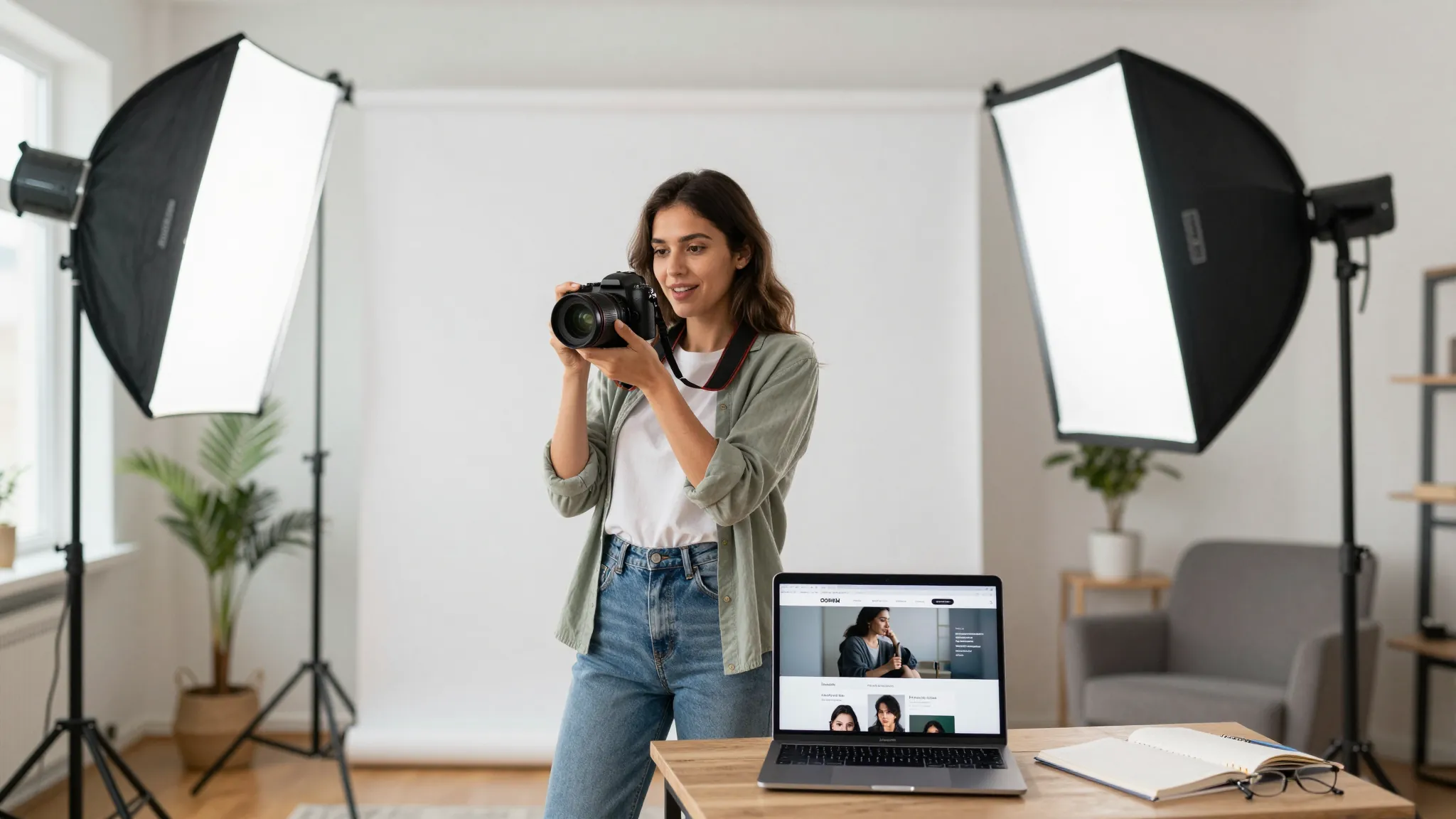
How to Start a Photography Business in 2026 (Complete Guide)
Roali (Roy) Biten
Founder, ROXO Hub · April 12, 2026
Get your photography business client-ready from day one
ROXO Hub gives photographers a live website, online booking, digital contracts, deposit collection, and client management — all for $39.99/month flat.
Start Your TrialIn this article
- 1.Table of Contents
- 2.1. Choose Your Photography Niche
- 3.2. Legal Business Setup
- 4.3. Essential Gear for 2026
- 5.4. Build Your Portfolio Before You Charge Full Rate
- 6.5. Price Your Photography Services Correctly From Day One
- 7.6. Find Your First Paying Clients
- 8.7. Contracts, Waivers, and Intake Forms
- 9.8. Set Up Online Booking
- 10.9. Market Your Photography Business
- 11.10. Track Revenue and Grow
- 12.Frequently Asked Questions
How to Start a Photography Business in 2026 (Complete Guide)
Most photographers who go pro within their first year don't fail because of bad photos — they fail because they undercharged, shot without contracts, and lost clients to competitors who made booking easier. The U.S. photography services market generates over $11 billion annually, yet a substantial portion of solo photographers close within three years — almost always for business reasons, not creative ones. In 2026, launching a photography business means competing against thousands of local shooters already on Instagram, listed on Google, and taking deposits online. This guide covers everything: choosing a niche, registering your business legally, building the right gear kit, setting prices, landing first clients, managing contracts, and setting up online booking so clients can hire you at 11 p.m. on a Sunday.
Table of Contents
- 1. Choose Your Photography Niche
- 2. Legal Business Setup
- 3. Essential Gear for 2026
- 4. Build Your Portfolio Before You Charge Full Rate
- 5. Price Your Photography Services Correctly
- 6. Find Your First Paying Clients
- 7. Contracts, Waivers, and Intake Forms
- 8. Set Up Online Booking
- 9. Market Your Photography Business
- 10. Track Revenue and Grow
1. Choose Your Photography Niche
Generalist photographers who shoot weddings, headshots, pets, and real estate all at once almost always earn less per hour than specialists. Clients pay premium rates for photographers who demonstrably understand their specific world. Choose a niche before you buy gear — your niche dictates which lenses, lighting, and editing workflow you actually need.
- Wedding photography: Packages run $1,500 (budget) to $6,000+ (mid-market) to $15,000+ (luxury). High earning potential, saturated in most cities.
- Commercial and product photography: Brands pay $500–$3,000 per day for studio work. Steady repeat clients, no weekends required.
- Real estate photography: $150–$400 per property. Lower per-shoot revenue, higher weekly volume possible.
- Newborn and family portraits: Sessions average $300–$600. Predictable seasonal surges in spring and fall.
- Corporate headshots: $200–$400 per person. Corporate accounts booking 10–50 people at a time generate $2,000–$20,000 per client annually.
- Boudoir photography: Average sessions sell for $800–$2,500 including prints. Strong referral culture within the niche.
2. Legal Business Setup
Operating without a business structure exposes your personal assets to any lawsuit arising from a session. Set this up before your first paid booking.
Business Structure
Most solo photographers start as sole proprietors and transition to an LLC once earning $30,000+ annually. LLC formation costs $50–$500 depending on your state — Wyoming ($100) and New Mexico ($50) have the lowest fees. You can file directly at your state's Secretary of State website without a lawyer.
Required Setup Steps
- Register your business name: File a DBA with your county for $10–$50, or form an LLC for full liability protection.
- Get a free EIN from IRS.gov: Takes five minutes. Required to open a business bank account and file taxes correctly.
- Open a dedicated business bank account: Chase Business Complete Banking or Relay ($0/month) both work well for solo photographers.
- Check local business license requirements: Most cities charge $25–$100/year for a general business license.
- Get insurance: General liability through Next Insurance runs $25–$40/month. Add equipment insurance if your kit exceeds $3,000 in value. Full Frame and Athos are photography-specific providers worth comparing.
3. Essential Gear for 2026
You don't need $10,000 of gear to launch. You need the right $2,000–$3,500 kit for your specific niche — nothing more until you're earning consistently.
Camera Bodies
- Sony a7 IV — $2,498: Benchmark full-frame mirrorless for portrait, wedding, and event work. Excellent low-light performance and subject-tracking AF.
- Canon EOS R6 Mark II — $2,499: 40fps burst and outstanding subject tracking, ideal for weddings and action.
- Nikon Z6 III — $1,999: Strong video specs for photographers offering photo + video packages.
- Sony a6700 — $1,398 (APS-C): Budget entry for real estate and lifestyle photographers who don't need full-frame.
Lenses by Niche
- Portrait and weddings: 85mm f/1.8 ($300–$500) plus a 24-70mm f/2.8 ($1,500–$2,200) covers 90% of situations.
- Real estate: Sony 12-24mm f/4 ($1,099) or a 16-35mm f/2.8 for wide interior coverage.
- Beginner general-purpose: 50mm f/1.8 — Sony: $248, Canon: $125. Exceptional quality for the price.
Lighting and Editing
- Godox AD200Pro — $339: Battery-powered portable strobe. The go-to starter flash for portrait and wedding photographers.
- Adobe Lightroom — $10.99/month: Industry standard for culling and color grading.
- Imagen AI — $9.99–$29.99/month: AI editing that culls and grades your work automatically — saves 3–5 hours per large gallery.
4. Build Your Portfolio Before You Charge Full Rate
Before you market yourself, you need 15–25 portfolio images strong enough that a stranger would book you on the spot. Those images don't need to come from paid work.
TFP Shoots
TFP (time for portfolio) is a trade: you shoot for free, the subject receives images for free, and both parties agree on usage rights in writing upfront. Find subjects through Model Mayhem or local Facebook creative groups. Be transparent about your current skill level — TFP with honest communication builds relationships; TFP with overselling destroys them before you've even launched.
Styled Shoots for Wedding Photographers
A styled shoot — collaborating with a florist, venue, cake designer, and models — produces portfolio images and builds vendor relationships that generate referrals for years. Budget $200–$500 to contribute to costs, then submit the images to Junebug Weddings or Green Wedding Shoes. A publication credit builds credibility before you've shot a single paying wedding.
Where to Host Your Portfolio
Your portfolio must live on your own website — not only on Instagram. Instagram buries posts older than 72 hours. Google cannot meaningfully index your Instagram gallery. Your own domain is what gets found in searches like "wedding photographer Austin" or "newborn photographer near me."
- Squarespace — $16–$23/month: Clean templates for photographers. No booking or contracts included.
- Pixieset — $8–$25/month: Purpose-built for photographers, includes client gallery delivery. Booking and contracts require additional paid integrations.
- ROXO Hub — $39.99/month: Includes website builder, online booking, payment processing, digital contracts, and client management in one subscription. A client-ready photography site goes live in about 15 minutes.
5. Price Your Photography Services Correctly From Day One
Underpricing is the most damaging mistake new photographers make — and it's structurally harder to fix than overpricing. Once clients know you as the affordable option, raising rates means losing your entire initial client base and rebuilding your positioning from scratch.
Calculate Your Floor Price First
Add your monthly overhead (gear amortization, software, insurance, marketing) and divide by realistic monthly session count. Add your minimum hourly rate multiplied by total hours per session — including editing and delivery, not just shoot time. A one-hour portrait session that takes four hours total at $30/hour means a floor of $120. Add overhead and a 30% margin, and $200–$250 is the correct starting rate — not $75.
2026 Photography Pricing Benchmarks
- Mini session (20–30 min): $100–$200, 10–15 edited images
- Standard portrait (1 hour): $200–$400, 20–35 edited images
- Extended family session (2 hours): $350–$600, 50+ images
- Wedding photography (8 hours): $2,500–$6,000
- Elopement (4–5 hours): $1,500–$3,000
- Real estate shoot (1–2 hours): $150–$400 depending on property size
- Corporate headshots (30 min per person): $200–$400 per person; $150–$250 per person on accounts of 10+
- Newborn in-studio session (2–3 hours): $350–$700
For a full breakdown including print add-ons, album pricing, and how to raise rates without losing rebooking clients, read our complete photography pricing guide for 2026.
6. Find Your First Paying Clients
The first 10 clients are the hardest to land — after that, referrals compound. Here's what actually works in 2026 for photographers with no existing audience:
Google Business Profile
Create and verify your free Google Business Profile at business.google.com. When someone searches "portrait photographer in [your city]," Google prioritizes local profiles with reviews, complete information, and recent photo uploads. This free listing frequently outperforms paid Instagram ads for photographers with 5+ real reviews.
Instagram Reels and TikTok
Behind-the-scenes content — your lighting setup, how you direct subjects, the before/after edit — consistently outperforms polished portfolio posts for organic reach. Post 3–4 Reels per week, always include your city and niche in the caption, and use location tags on every post. Clients search Instagram geographically when looking for local photographers.
Wedding and Event Directories
For wedding photographers, The Knot and WeddingWire charge $50–$100/month depending on your market and dominate couples' vendor research. Thumbtack (pay-per-lead model) works well for portrait and event photographers. Expect 3–6 months before directory listings generate consistent inbound leads.
Vendor Referral Networks
A single relationship with a wedding planner or venue coordinator is worth 5–20 referral bookings per year. Offer to photograph a vendor's portfolio for free or discounted in exchange for being on their preferred vendor list. One strong venue relationship can fill a significant portion of your annual calendar at zero ongoing marketing cost.
7. Contracts, Waivers, and Intake Forms
A contract prevents scope creep, delivery disputes, and payment arguments. Every paid session needs one — including sessions for friends and family. Every single time.
What Your Photography Contract Must Include
- Deliverables: Exact number of edited images, file formats, delivery platform, and timeline in business days.
- Payment terms: Total price, deposit amount if applicable, balance due date, accepted payment methods.
- Cancellation policy: What happens to the deposit if the client cancels within 48 hours vs. 30 days. Specify clearly — "non-refundable deposit" is enforceable only when documented before payment.
- Image usage rights: Who can use the photos, for what purpose, and whether you retain portfolio and marketing rights.
- Model release: Written consent to use images in your marketing. Without a signed release, you cannot legally post client photos publicly.
- Limitation of liability: What you're liable for if equipment fails, files corrupt, or you're unable to complete the session due to illness.
- Force majeure: What happens if a weather event, venue closure, or emergency affects the session date.
Professional photography contract templates are available on Creative Market for $15–$50. For a full customizable template with clause explanations, read our photography contract template guide.
ROXO Hub includes digital intake forms, contracts, and client waivers as part of the platform. Clients receive a link, sign online in under two minutes, and the signed copy is stored automatically in their client profile — no PDFs, no follow-up emails asking whether they received the contract.
8. Set Up Online Booking
Clients who cannot book you in under three minutes will book someone else. In 2026, "email me to schedule" is a conversion killer. Clients expect to see your real-time availability, select a session type, pay a deposit if required, and sign a contract — all in one flow, on their phone, at whatever time they happen to be ready.
Online Booking
Clients self-book 24/7 from your ROXO Hub website. No app download required on their end.
Digital Contracts
Send, sign, and store contracts automatically as part of the booking flow.
Deposit Collection
Optionally require a deposit at booking to remove uncommitted clients from your calendar.
Website Builder
Get a client-ready photography website live in about 15 minutes — included in your subscription.
Auto Reminders
Automated SMS and email reminders reduce last-minute no-shows without manual follow-up.
Instant Payouts
Get paid same day — no waiting 2–5 business days for transfers to clear.
Booking Software Comparison for Photographers
| Platform | Price | Online Booking | Contracts | Website Included | Payments |
|---|---|---|---|---|---|
| ROXO Hub | $39.99/mo | ✓ | ✓ | ✓ | ✓ |
| HoneyBook | $19–$79/mo* | ✓ | ✓ | ✗ | ✓ |
| Dubsado | $20–$40/mo* | ✓ | ✓ | ✗ | ✓ |
| 17hats | $45/mo* | ✓ | ✓ | ✗ | ✓ |
| Squarespace + Acuity | $32–$39/mo combined | ✓ | ✗ | ✓ | Partial |
*Pricing as of 2026 — verify directly with each provider.
ROXO Hub is the only option in this comparison that includes a website, online booking, digital contracts, and payments in a single $39.99/month flat-rate subscription. HoneyBook and Dubsado require a separate website subscription, adding $16–$23/month to their base cost. ROXO Hub also lets you optionally require a deposit at the time of booking — if you enable deposit collection, it's charged when the client confirms. This removes uncommitted clients before they block your calendar. Clients do not need to download any app; they book directly from your ROXO Hub photography website.
For a full feature-by-feature breakdown of every booking platform available to photographers, read our best booking software for photographers in 2026 guide.
9. Market Your Photography Business
Once your portfolio is ready, your pricing is set, and your booking system is live, marketing is how you go from zero to a full calendar. Focus on two or three channels in your first 90 days — doing three things consistently beats ten things sporadically.
Instagram Reels and TikTok
Short-form video is the dominant discovery channel for photographers in 2026. A 30-second Reel showing your lighting setup, subject direction, and final image regularly reaches 10,000–50,000 people organically in metro markets. Include your city and niche in every caption; use location tags every time.
Local SEO
Ranking for searches like "newborn photographer in Denver" drives high-intent leads — people actively looking to hire right now. Include your city and niche in your homepage title tag, meta description, and first paragraph. Create individual pages per service type and publish 2–4 blog posts per month targeting local search terms. Organic results take 4–6 months to appear but compound indefinitely.
Google Reviews
A Google Business Profile with 15+ five-star reviews dramatically increases your chances of appearing in Google's local map pack. Send a review request within 24 hours of delivering images, while the experience is fresh. ROXO Hub's marketing tools let you automate post-session follow-up messages to collect reviews without manually tracking who to contact after every shoot.
Email Marketing and Gift Cards
A list of 200 past clients and warm leads is worth $1,000–$3,000 per campaign when you announce a mini session event or seasonal booking window. Mailchimp (free up to 500 contacts) or Flodesk ($38/month) are standard choices. ROXO Hub's built-in gift card feature lets clients purchase digital or physical gift cards directly from your website — a reliable source of revenue in the 3–4 weeks before Mother's Day, Christmas, and Valentine's Day.
Referral Incentives
For every client who sends a paying referral, offer a $50 print credit or a complimentary add-on at their next session. Document this in your post-session delivery email and mention it once at the end of each shoot. A small, clearly articulated incentive meaningfully increases how often satisfied clients recommend you.
10. Track Revenue and Grow
Photographers who hit $50,000 in gross revenue often feel financially successful until they calculate their actual hourly rate — frequently $12–$18/hour after accounting for editing time, admin, marketing, and gear. Tracking your real numbers is what separates a profitable business from an expensive hobby.
Key Metrics to Track Monthly
- Revenue by service type: Which sessions generate the best return on your time? Double down on those.
- Bookings by source: Are clients finding you through Instagram, Google, referrals, or directories? Invest more energy where results are coming from.
- Average booking value: At $250 average, reaching $50,000 requires 200 sessions — nearly four per week. At $400 average, you need 125. Raising your average changes your entire lifestyle.
- Cancellation rate: A high rate signals that you need to enable optional deposit collection at booking to filter uncommitted inquiries before they block your calendar.
- Rebook rate: Returning clients cost nothing to acquire. A family portrait client who rebooks every spring and fall is a $500–$1,200 annual relationship with zero marketing spend.
ROXO Hub's Reports and Analytics dashboard shows revenue by time period, bookings by service type, and client history in one place — no manual spreadsheet required. Instant Payouts means you receive payment same-day rather than waiting 2–5 business days.
When to Raise Your Prices
Raise your prices when you're consistently booking out more than three weeks in advance. A 15–20% increase applied to new inquiries — while honoring existing bookings at current rates — rarely causes significant churn if your work has continued to improve. If you have a waitlist, your prices are below market value.
Scaling Beyond Solo
Once you're earning $60,000–$80,000 consistently as a solo photographer, growth paths include: hiring a second shooter for weddings ($300–$600/day), bringing on an associate photographer for lower-budget sessions under your brand, or building passive revenue through presets, workshops, or online courses. ROXO Hub's Scheduling Calendar supports team scheduling, so adding a second shooter doesn't require switching platforms.
Frequently Asked Questions
How much does it cost to start a photography business?
A functional starter kit — one mirrorless body, two lenses, a portable strobe, memory cards, and editing software — runs $2,500–$4,000. Add $50–$500 for business registration, $25–$40/month for insurance, and $39.99/month for ROXO Hub, and first-year overhead is approximately $4,000–$6,500 before marketing.
What photography niche makes the most money?
Wedding photography has the highest per-event revenue at $2,500–$15,000+, while commercial product photography offers the strongest hourly rate with repeat clients at $500–$3,000 per day. Corporate headshot photographers who land business district accounts booking 20+ employees at $250 each can generate $5,000 in a single day.
Do I need an LLC to start a photography business?
You don't legally need one to accept paid work, but without an LLC your personal assets are exposed to any session-related lawsuit. Most photographers operate as sole proprietors initially and form an LLC once earning $30,000+ annually — formation costs $50–$500 depending on your state.
What camera should I buy to start a photography business?
The Sony a7 IV ($2,498) and Canon EOS R6 Mark II ($2,499) are the benchmark full-frame mirrorless bodies for portrait, wedding, and event photographers in 2026. Budget-constrained photographers should consider the Sony a6700 ($1,398) or Nikon Z6 III ($1,999). The camera body matters less than the glass — never underspend on lenses.
How do I price my photography services as a beginner?
Calculate your floor price first: overhead divided by monthly session capacity, plus minimum hourly rate multiplied by total hours per session including editing. Research local competitor pricing, enter at or slightly below mid-market, and plan your first price increase after completing 20–30 paid sessions with testimonials to back the new rate.
How do I get my first photography clients with no experience?
Create a free Google Business Profile, post behind-the-scenes Reels 3–4 times per week with your city in the caption, and complete 3–5 TFP shoots to build your initial gallery. Reach out directly to 10–15 complementary local vendors — florists, venues, planners, makeup artists — and offer to shoot their portfolio in exchange for referrals.
Do I need a contract for every photography session?
Yes — every paid session, including sessions for friends and family. A contract protects you from payment disputes, delivery arguments, and scope creep. Without one, you have no legal recourse if a client refuses to pay or demands more work than you agreed to deliver.
How do photographers get paid?
Most photographers collect a non-refundable deposit (25–50% of total) at booking with the balance due before or at the session. ROXO Hub supports cards, Apple Pay, and tap-to-pay without a card reader, and offers optional same-day payouts so you're not waiting days for funds to clear.
What business licenses do I need for photography?
Most cities require a general business license ($25–$100/year). If you operate under a business name rather than your legal name, file a DBA. If you sell prints or physical products, check whether your state requires a sales tax permit. Verify your city, county, and state requirements before your first paid booking.
How do I build a photography portfolio from scratch?
Complete 3–5 TFP shoots in your target niche — recruit subjects through Model Mayhem or local creative Facebook groups. For wedding photographers, join or organize a styled shoot with complementary vendors. Aim for 15–25 cohesive, polished images before marketing yourself, and host the portfolio on your own website so it's searchable on Google.
Should I specialize in one photography niche or offer multiple services?
Specialize first, then expand. Specialists command higher rates, generate stronger referrals within their niche, and build a clearer brand identity. Start with one primary niche and one complementary secondary service — trying to serve every niche from day one produces an unfocused portfolio that convinces no one to hire you.
How much should I charge for a portrait session?
In 2026, standard portrait sessions run $200–$400 per hour nationally, with mini sessions (20–30 minutes) at $100–$200 and extended family sessions (2 hours) at $350–$600. Rates vary significantly by city — research local competitors before setting yours, and never undercut the market by more than 10–15% as a new photographer.
How do I protect myself from photography no-shows and cancellations?
ROXO Hub lets you optionally require a deposit at booking — if you enable this, it's charged when the client confirms, filtering out low-commitment inquiries before they block a date on your calendar. You can also store a card on file for no-show protection. Define your cancellation policy explicitly in your contract before the client pays.
What editing software do most photographers use?
Adobe Lightroom ($10.99/month) is the industry standard with the largest ecosystem of presets and plugins. Capture One ($24/month) is preferred by commercial and fashion photographers for its superior color rendering. Imagen AI ($9.99–$29.99/month) automates culling and grading using AI trained on your personal editing style, saving 3–5 hours per large gallery.
How do I market my photography business on Instagram?
Post Reels — not static images — showing behind-the-scenes process, posing direction, and before/after edits 3–4 times per week. Include your city and niche in every caption, use location tags on every post, and respond to comments within the first hour to signal engagement to the algorithm. Process content consistently outperforms polish-only accounts for organic local reach.
Do I need insurance as a photographer?
Yes. General liability insurance is essential for any photographer working on location or in clients' homes — a single property damage claim without coverage can cost more than a full year of premiums. Next Insurance offers policies starting at $25–$40/month for photographers. Add equipment insurance through Full Frame or Athos if your gear value exceeds $3,000.
What is a model release form and do I need one?
A model release is written consent from your subject granting you the right to use their likeness in your marketing and portfolio. Without a signed release, you cannot legally post client images to Instagram, your website, or any public channel. ROXO Hub's digital forms let you collect signed releases automatically as part of your booking workflow.
How long does it take to start making money from photography?
With consistent marketing — posting regularly, setting up a Google Business Profile, and networking with local vendors — most photographers land their first 3–5 paid bookings within 60–90 days of actively promoting their services. Replacing a full-time income typically takes 12–24 months of sustained effort and disciplined pricing.
Should I use HoneyBook or Dubsado for my photography business?
Both are solid CRM platforms, but neither includes a website — meaning you pay $19–$40/month for the CRM plus $16–$23/month for a website builder, totaling $35–$63/month for less functionality than ROXO Hub's $39.99/month all-in-one subscription. For photographers wanting website, booking, contracts, and payments in a single platform, ROXO Hub is the more cost-effective choice.
What is the best online booking system for photographers in 2026?
ROXO Hub is the strongest all-in-one option for photographers who want a website, online booking, digital contracts, and payment processing under a single $39.99/month subscription. For photographers who already have a website and want a booking-only add-on, Acuity Scheduling ($16–$27/month) integrates with most website builders.
How do I collect a deposit for photography sessions?
Through ROXO Hub, you can optionally enable deposit collection at booking — clients pay the deposit amount when they confirm their session date, and the remaining balance is collected at or before the shoot. You set the deposit amount (typically 25–50% of the package total) and the cancellation terms. This is a feature you configure — it is not applied automatically to all bookings.
Can I run a photography business from home?
Yes — most portrait, wedding, and lifestyle photographers operate from home with no commercial studio. For newborn or boudoir photography requiring a studio, rent space hourly through PeerSpace ($30–$80/hour) until booking volume justifies a dedicated space. Many photographers build complete six-figure businesses operating entirely from home using a mix of on-location and rented studio sessions.
How do I set up a photography business website?
The fastest path is ROXO Hub's built-in website builder — it includes online booking, contact forms, service pages, and payment integration, and goes live in about 15 minutes as part of your $39.99/month subscription. Whichever platform you choose, your website needs: a clear niche statement, your city, a portfolio gallery, pricing or pricing ranges, and a direct booking button above the fold.
Stop losing bookings to a complicated scheduling process
While you work through pricing and portfolio building, ROXO Hub handles your calendar, contracts, and payments so clients can book you in under three minutes.
Try ROXO HubReady to run your photography business smarter?
Setup takes 15 minutes. No contracts. Cancel anytime.
Roali (Roy) Biten
Founder, ROXO Hub
Disclaimer: The content in this article is provided for informational purposes only. ROXO Hub strives to publish accurate and helpful information, but we make no guarantees about the completeness, reliability, or accuracy of the content. Information may change over time and may not reflect the most current developments. Always conduct your own independent research and consult qualified professionals before making business decisions. ROXO Hub is not liable for any errors, omissions, or outcomes resulting from reliance on this content. Terms of Use.